

Blog
Goran Arsovski, “Aris”: We Do Not Compromise on Quality

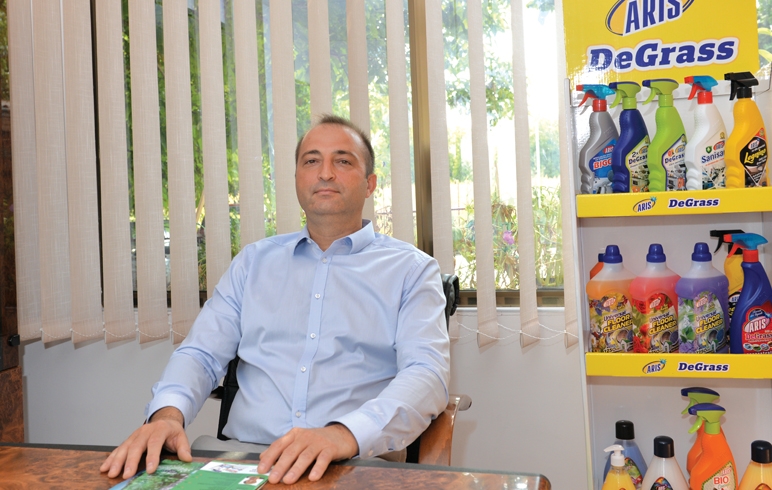
In this interview with InStore, General Manager Goran Arsovski takes us on a journey back to the founding of the company, while also looking ahead toward future plans and innovations.
“A decision that brought a turning point in the company’s development was the production of degreasers (odmrsnuvači). Until then, everyone thought a ‘degreaser’ was something related to defrosting. In this segment of the Macedonian market, there was no product, no habit, and no perceived need. We managed to educate consumers, and to create and satisfy that need. In doing so, we built the brand loyalty we still enjoy today,” Arsovski noted.
The company “Aris” has been operating on the Macedonian market for 26 years. Can you tell us more about the beginnings and the challenges you faced?
Our company began operating in 1993. It all started with a friendship with the owners of a cleaning product manufacturing company from Italy. We saw that our market had the capacity and the need for innovation in this industry. At that time, there were only large companies like OHIS and Alkaloid; besides ours, I think there was only one other company, which has since folded. We became one of the first private companies to enter this business.
Back then, we faced bureaucratic obstructions because the “big players” controlled the market. We started as a chemical workshop with limited production (up to 16 tons) and restricted space. Over time, we adapted to the changes that came our way.
How difficult was it to enter and place products in large retail chains? Where can your products be found now?
Key Accounts (KA) do not take products just to have them sit on the shelf. They don’t want to be responsible for whether an innovation succeeds or fails. They want products that “move” off the shelf; I assume that is their policy, which includes covering their own costs. Even now, we face hurdles when offering innovations. Regardless of the invention, they are interested in the turnover rate per shelf over a specific period.
From that perspective, we had more problems back then. We weren’t present in major KAs until 2008, when we started collaborating with “Tediko.” We decided to invest more in a national TV campaign, after which they agreed to place our products. Subsequently, our products found their place on the shelves of other KAs. Today, we work with almost everyone, with a few exceptions.
We have had great cooperation with hard discounters, especially Kam and Kipper. That cooperation focuses on high-turnover products; you can’t necessarily “build” a brand there, but the partnership is successful because the terms are favorable.
How is the company’s distribution organized?
The company employs 6 sales representatives and 3 drivers. In areas where we don’t handle our own delivery, we work with sub-distributors. They are distributed regionally; each cares for their own sales but also has the exclusive right to develop and maintain the brand. Our products can be found throughout Macedonia, but also in Serbia, Kosovo, and parts of Bosnia and Herzegovina.
Are you planning to expand exports?
Yes, Albania is a very interesting market. But realistically, we would be a new brand there, and new brands are usually compared solely on price. We don’t want to be compared that way; we have a lot to offer in terms of quality and cannot compete on price alone. Once a brand is known, it is compared based on quality and user satisfaction. We cannot lower prices because that would mean lowering quality—and we never compromise on quality.
What are the main characteristics of Aris brands that set them apart? What is your leading brand?
Aris collaborates with an Italian company that provides us with innovations already accepted in the Italian market. The extent to which these new formulas are accepted here depends on purchasing power, consumer habits, and cultural differences. Experience has shown that these products are well-received. I can confirm that Aris products do exactly what they are intended for; their functionality is what sets them apart. This is why our products may appear to have a higher price. However, detergents must work; it is useless to have a lower price if you have to buy three different products for the same purpose.
Our leading brand, without a doubt, is Aris DeGrass. Driven by consumer feedback, we created two new variants: one with a mild lemon scent and another that is double-concentrated.
What was your last major investment? What are the plans for the coming years?
This year, we invested in a new automatic filling line. We don’t have other major investments planned for the immediate future, as that will depend on capturing new markets. When we expand further, we will naturally need to expand capacity.
To what extent does the political situation affect business and investment decisions in the region?
Regarding the economic and political strategy of any government, what matters most to us as part of the real sector is stability. Direct financial aid or incentives are not as vital as long-term stability for investment.
Another problem we face is a lack of infrastructure and land. We’ve been in situations where we bought a plot only to find out later it was contested in court. In Kumanovo, for example, there is no industrial zone, so when we need to invest in a new plant, we hit a wall. This is a technical and bureaucratic problem, not a financial one. We simply need rule of law, fast decision-making, and stability.
What is your current production capacity utilization? Do you plan to increase it?
Our products are seasonal; from Easter to October, production doubles. This is likely linked to spring and autumn cleaning, home renovations, and the influx of people from abroad during those months. Based on experience, we now consciously build up stock during the winter to meet that peak demand.
We’ve seen growth this year, continuing a trend of 8% to 10% annual growth over the last decade. It is a small but steady increase. During summer, our capacities are at 100%.
Late payments are a major challenge in the Macedonian FMCG sector. Is this a struggle for Aris?
We do not enter into “credit relationships” by providing goods without payment. If a product is sold and collected within a month, we expect to be paid within a month. We provide a grace period aligned with our clients’ sales cycles, but we cannot “finance” their business operations. So far, our collections have been relatively good. This might result in slower growth, but the goal is sustainable profit.
How have working conditions in Macedonia changed over the years?
They have changed a lot. We have an open market now. People with even modest capital decide to import products, but they aren’t always of verified quality. Importers try to enter with very low prices, and when they realize after a few years that it isn’t sustainable, they slash prices even further to exit the market. This puts us under constant pressure from economically unjustified low prices.
Additionally, importers with large budgets offer “buy one, get one” deals, which has trained consumers to expect promotions. We don’t calculate our business that way. We do run promotions, but only for specific periods and quantities.
Are you considering bio or organic products?
Yes. Starting in October, we will be importing a full line of organic cosmetics and cleaning products from a company in Bologna. These are true bio-products without preservatives or toxins. Because they are natural, they have a shelf life of only six months.
Bio-products are the future, but because the market segment for them is currently small in Macedonia, we couldn’t justify manufacturing them ourselves yet. That is why we chose to import.
Who sets the trends in the FMCG sector: manufacturers, distributors, or retailers?
I believe it is the retailers. For example, we are currently in a “waiting” position with two KAs. Despite constant growth in their stores, they decided to pause cooperation because certain expectations regarding positioning against other chains or discounters weren’t met. It is impossible to please everyone.
I believe the future of retail lies with hard discounters. As long as purchasing power remains low and they stick to their strategy of curated brand selection, their growth is guaranteed—provided they don’t sacrifice quality for price.
Do you see e-commerce as the future?
Absolutely. Our plans are moving in that direction. Initially, our e-shop wasn’t intended for our main brands but for the organic products we are importing. Since those are premium products that won’t be in conventional stores, an e-shop is the best way for customers to reach them.
The challenge with our standard brands is their low unit price; shipping costs can sometimes equal the price of the product itself. To solve this, we plan to offer bundles (500 to 1,000 MKD) with free delivery. We expect the e-shop to be functional by October.
What are your projections for the end of 2019?
We can only increase profitability by conquering new markets. Increasing production solely for the domestic market would be counterproductive. We can also improve margins by reducing production costs, but that is difficult as wages and manufacturing expenses are rising. We are absorbing these costs for now, but we will likely have to revise our prices slightly—not drastically, but enough to maintain profitability. By the end of the year, we expect our usual growth of 8% to 10% in both production and revenue.


